|
Hanja
Getting hanja characters for korean words
|

|
|
Hanja
Getting hanja characters for korean words
|
|
A class to handle database operations for managing Korean words and their associated Hanja characters. More...
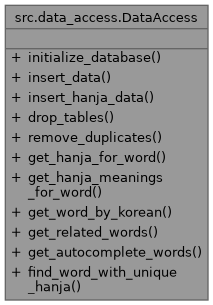
Public Member Functions | |
| initialize_database (self) | |
| Initializes the database by creating necessary tables if they don't already exist. | |
| insert_data (self, processed_data) | |
| Inserts processed data into the 'korean_words' table. | |
| insert_hanja_data (self, hanja_dict) | |
| Inserts Hanja data into the 'hanja_characters' table. | |
| drop_tables (self) | |
| Drops the 'hanja_characters' and 'korean_words' tables if they exist. | |
| remove_duplicates (self) | |
| get_hanja_for_word (self, word) | |
| Retrieves Hanja associated with a given Korean word. | |
| get_hanja_meanings_for_word (self, word, hanja_list, language) | |
| Retrieves Hanja meanings of every characters associated with a given Korean word. | |
| get_word_by_korean (self, korean_word, language, hanja_characters=None) | |
| get_related_words (self, hanja_character, language) | |
| Gets all the words that contains the specified hanja character. | |
| get_autocomplete_words (self, query, limit=10) | |
| Fetches a list of word suggestions that start with the provided query. | |
| find_word_with_unique_hanja (self) | |
| Finds a Korean word where at least one Hanja character is unique to that word. | |
A class to handle database operations for managing Korean words and their associated Hanja characters.
| src.data_access.DataAccess.drop_tables | ( | self | ) |
Drops the 'hanja_characters' and 'korean_words' tables if they exist.
| src.data_access.DataAccess.find_word_with_unique_hanja | ( | self | ) |
Finds a Korean word where at least one Hanja character is unique to that word.
| src.data_access.DataAccess.get_autocomplete_words | ( | self, | |
| query, | |||
limit = 10 |
|||
| ) |
Fetches a list of word suggestions that start with the provided query.
| query | The prefix to search for. |
| limit | Maximum number of results to return. |
| src.data_access.DataAccess.get_hanja_for_word | ( | self, | |
| word | |||
| ) |
Retrieves Hanja associated with a given Korean word.
| word | (str): The Korean word for which to fetch Hanja character. |
| src.data_access.DataAccess.get_hanja_meanings_for_word | ( | self, | |
| word, | |||
| hanja_list, | |||
| language | |||
| ) |
Retrieves Hanja meanings of every characters associated with a given Korean word.
| word | (str): The Korean word for which to fetch Hanja meanings. |
| hanja_list | (list): The list of hanja associated to the initial words. |
| language | (str): The language of the page. |
| src.data_access.DataAccess.get_related_words | ( | self, | |
| hanja_character, | |||
| language | |||
| ) |
Gets all the words that contains the specified hanja character.
| hanja_character | the hanja character to search for. |
| language | The language for the definition |
| src.data_access.DataAccess.get_word_by_korean | ( | self, | |
| korean_word, | |||
| language, | |||
hanja_characters = None |
|||
| ) |
@brief Fetches a word entry by its Korean text.

@param korean_word: The Korean word to search for.
@param language: The language for the definition
@return: A list of matching entries.
| src.data_access.DataAccess.initialize_database | ( | self | ) |
Initializes the database by creating necessary tables if they don't already exist.
korean_words
id (INTEGER, PRIMARY KEY): Unique identifier for each word.word (TEXT, NOT NULL): Korean word.hanja (TEXT): Associated Hanja characters.glossary (TEXT): Word's glossary or definition in Korean.englishLemma (TEXT): Lemma/word in English.englishDefinition (TEXT): English definition of the word.frenchLemma (TEXT): Lemma/word in French.frenchDefinition (TEXT): French definition of the word.hanja_characters
id (INTEGER, PRIMARY KEY AUTOINCREMENT): Unique identifier for each Hanja character.character (TEXT, NOT NULL, UNIQUE): The Hanja character.korean (TEXT, NOT NULL): Korean pronunciation of the Hanja.englishDefinition (TEXT): Meaning of the Hanja character in english.frenchDefinition (TEXT): Meaning of the Hanja character in french.pronounciation (TEXT): html link of audio for the word's pronounciation.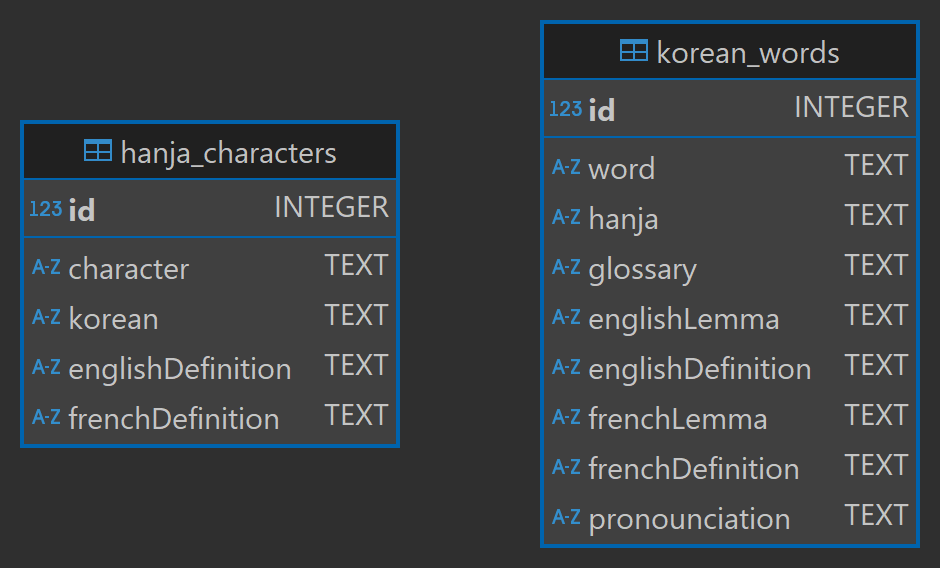
| src.data_access.DataAccess.insert_data | ( | self, | |
| processed_data | |||
| ) |
Inserts processed data into the 'korean_words' table.
| processed_data | (list): A list of dictionaries containing word data. Each dictionary should have:
|
| src.data_access.DataAccess.insert_hanja_data | ( | self, | |
| hanja_dict | |||
| ) |
Inserts Hanja data into the 'hanja_characters' table.
| hanja_dict | (dict): A dictionary mapping Hanja characters to a list of related Korean data. Example: {
'漢': [{'kor': '한', 'englishDefinition': 'China'}, 'frenchDefinition': 'Chine'}],
'字': [{'kor': '자', 'englishDefinition': 'Character'}, 'frenchDefinition': 'Caractère'}]
}
|
| src.data_access.DataAccess.remove_duplicates | ( | self | ) |
 1.9.8
1.9.8